
Prince George's County City Directory Holdings
No single county-wide directory series covers Prince George's County from start to finish. Instead, the printed trail here is suburban and municipal. The holdings mix Polk directories, town-specific books, selected Washington metropolitan telephone volumes, and local-history compilations. That patchwork shapes every search. A family in Laurel may show up in one book while a Hyattsville household lands in another, and a telephone subscriber is not always listed in a Polk resident section. Start with the place and the decade. Then ask the holding institution to confirm the physical volume or reel, because a year cited only in a bibliography may not match what sits on the shelf.
| Collection | Years | Where Held | Access |
|---|---|---|---|
| R.L. Polk Maryland-Washington Suburban Directory | 1930-31; 1954-55 verified | PGC Genealogical Society, PGCMLS and local-history collections | Verify the volume or microfilm onsite |
| Polk's Laurel City Directory | 1962 | Maryland State Archives, location 10-3-2 | Archive catalogue and collection access |
| Maryland and Washington telephone directories | Selected 1933-45, 1952, 1955, 1960/61, 1963/64 and 1971-73 reels | Library of Congress and library microfilm | Digitized reel or library access |
| White Pages, Maryland Suburban Section | October 1971-1973 | Library of Congress reels and libraries | Listed-line research only |
| Laurel Centennial history | 1970 book with 1894 names | PGCMLS Maryland Room, PGCGS and PGCHS | Local-history reference |
For the Laurel volume, the Maryland State Archives directory holdings are the natural first stop. Gaps happen for ordinary reasons. Publication ran irregularly. Some households went unlisted, and one reel may cover only a slice of the metropolitan area. A missing line is not proof that anyone left the county. The official directory-holdings catalogue maps the archival route for Prince George's County directory research. It beats guessing.
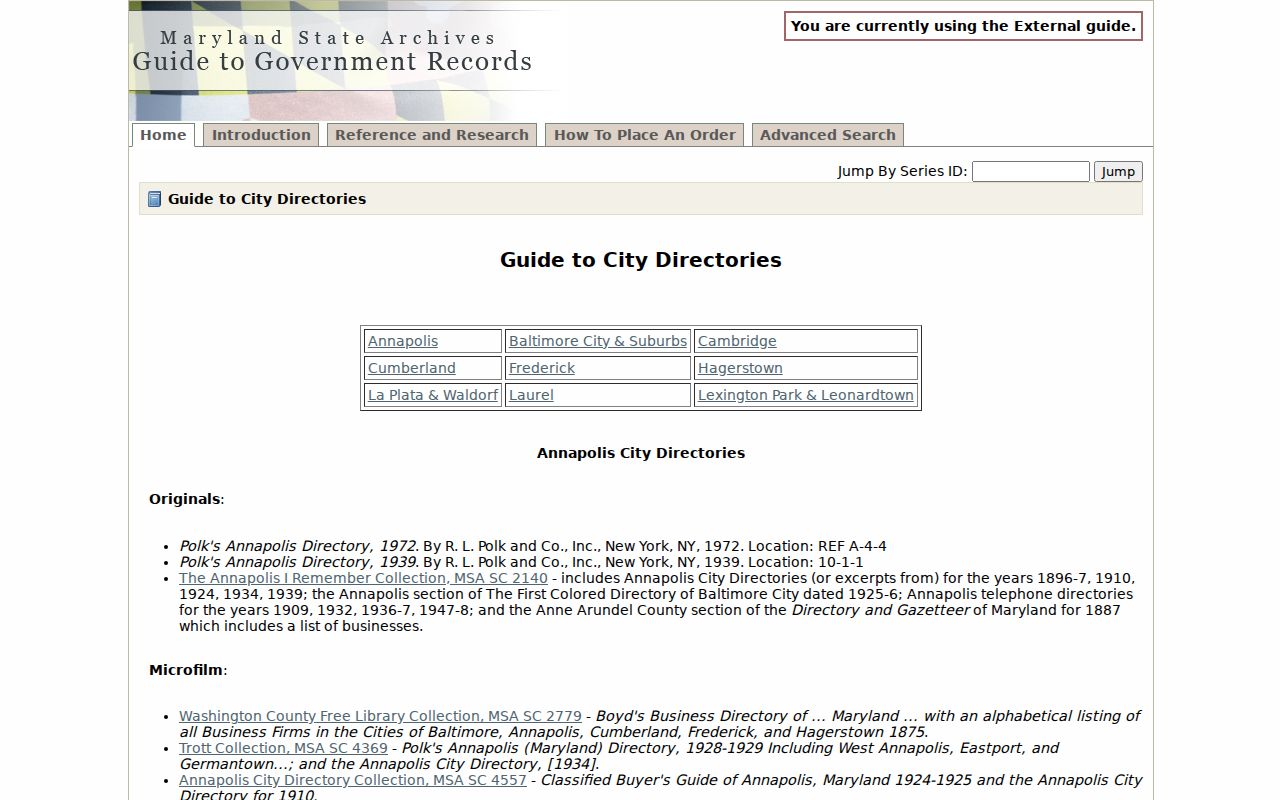
Use those catalogue details when requesting a book or reel. That step matters most when your search begins with a town name rather than the county.
Prince George's County Directory Geography
Postal cities and municipal lines do not form a tidy directory boundary. This is especially true in Prince George's County. Bowie, College Park, Greenbelt, Hyattsville, Laurel, and Upper Marlboro each carry their own local history. Unincorporated communities often share a postal label with a larger town. For older research, keep three things together in your notes. These are the town name as printed in the book, the street name, and the county. A suburban Washington directory may group a place differently from a county record.
This records geography matters for family history, classmate searches, heir tracing, and historic-house work. It guards against a false negative. That is where an address sits outside the incorporated line yet still uses that city name in its mail. When a directory heading clashes with the modern map, a legal description or an old plat can bridge the changed postal label.
Note: A postal city on an old entry reflects the book's addressing convention, not a definitive municipal boundary.
Polk City Directories for Prince George's
R.L. Polk is the clearest publisher name on the local directory shelf. The Maryland-Washington Suburban Directory is verified for 1930-31 at the Prince George's County Genealogical Society. It is also verified for 1954-55 in local bibliography. Polk's Laurel City Directory was printed in Richmond. It is verified for 1962 in the State Archives catalogue. Treat these as strong leads, not proof of a seamless annual series. Before trusting a volume, confirm its page sequence and town coverage. Also check whether it carries a reverse street section.
A Polk-style entry can yield a name, street address, occupation, and business listing. It occasionally carries a relationship notation too. Run surname searches with initials and spelling variants. Front and back matter sometimes names institutions and principals. This helps separate two residents who share a name. One caution applies: a directory line is not evidence of a present-day address.
Prince George's Telephone Directory Reels
Telephone books form a separate Prince George's County directory path. The Library of Congress holds selected Washington Metropolitan years from 1933 through 1945, a Hyattsville reel covering 1935-37, and selected local years through 1973. White Pages Maryland Suburban Section volumes are verified for October 1971, 1972, and 1973. A listed name and address can link a household between census dates. An unlisted phone, though, proves nothing about vacancy or absence.
The Library of Congress digitized telephone-directory reel lets you study the arrangement before visiting. Search both the name and address paths where the volume offers them. Then compare adjacent years, since one listing never adds up to a complete household roster.
Prince George's Room City Directories
When no web index returns a result, the noncirculating Prince George's Room offers the most direct local fallback. The room sits at the rebuilt Hyattsville Branch. Its holdings span local newspapers on microfilm, historic assessment books, court proceedings, and Sanborn fire-insurance maps. A reader for microfilm and microfiche is available on site. Newspaper titles include the Prince George's Sentinel and the Prince George's Post. The Bowie Blade and the Laurel Leader are held there too. Together these sources can test a directory address against notices, property context, and community names. The Prince George's Room page describes the local-history collection and its in-person research setting.

Arrive prepared. Bring name variants, the address, a likely year range, and the municipality so staff can point you to the right microfilm, assessment book, or map.
DeMarr's Prince George's Directory Files
DeMarr Library sits below the Greenbelt Library building. Its shelves hold roughly 6,000 volumes of county history. Maps, archival photographs, journals, newspapers, and files on people and places fill out the rest. Use is free, copy fees are nominal, and research help comes by phone or email. The Genealogical Society library nearby adds more than 6,500 volumes of its own. It also keeps maps, family files, Bible records, microforms, and help with research requests. A directory trail sometimes stalls. These two Prince George's County collections often pick it back up. DeMarr Library and Archives describes its people-and-places collections and how to reach them.

Request materials by neighborhood, person, and rough date. Keep a citation for every volume, reel, or file you consult.
Read a Prince George's City Directory
Treat a historical directory entry as an index lead rather than a certified identity record. The Library of Congress outlines the usual arrangement: a surname with given name or initials, an address, a listed telephone number in phone books, and occasionally an occupation or a spouse or widow notation. Polk-style volumes often add business and civic sections too. One caution applies to Prince George's County. Owner and renter symbols cannot be assumed for every run, so copy that volume's abbreviation key before you translate any mark.
| Name heading | Surname with given name or initials; check nearby spellings and initials. |
|---|---|
| Address | Street number and name, often usable in a reverse or address section where present. |
| Telephone | Listed exchange and number in telephone directories; omission does not establish vacancy. |
| Occupation or listing | May appear in a historical directory, but is not guaranteed in a white-pages section. |
| Household notation | Spouse, relationship, or widow notation may appear; confirm the volume's own key. |
| Section placement | Alphabetical, classified, and reverse/address sections are separate search paths. |
- Criss-cross directory
- An address-order section that can lead from a house number and street to a listed occupant or telephone subscriber.
- Householder index
- A name arrangement that usually points to the entry for a household head, not every person at the address.
- Abbreviation key
- The volume's explanation of its shorthand. Read it before deciding what a widow, relationship, or other mark means.
Prince George's County Directory Timeline
County records reach back to 1696. Directory history here is a later and uneven suburban story, though. A resident-name list from 1894 survives inside Laurel's 1970 centennial history. Verified Polk suburban volumes follow for 1930-31 and 1954-55, with Polk's Laurel edition for 1962. Telephone reels for Washington and Hyattsville fill parts of the 1930s through 1970s. The Library of Congress collection spans much of the nation from 1861 to 1960. Local reel coverage, though, stays irregular.
- 1894: resident names are preserved within Laurel's centennial-history source.
- 1930-31: a Polk Maryland-Washington Suburban Directory run is verified locally.
- 1962: Polk's Laurel City Directory is catalogued at the Maryland State Archives.
- 1971-73: Maryland Suburban white-pages volumes provide a listed-line trail.
That sequence lists verified finds, not the first or last possible Prince George's County volume. For dates in between, ask an archive or library.
Trace Prince George's City Directory Households
Follow a household across several directory years instead of trusting one entry. Start by normalizing the street name, direction, suffix, ZIP, and municipality. Then work the name section with surname variants, initials, spouse terms, and widow terms. If a reverse section exists, search the address too. A directory can place a person near a date. Yet a move can open a gap. So can an unlisted line. So can an irregular publishing year.
- Record the first directory appearance with the exact name, address, source title, and page.
- Check the previous and following years for a move, initial change, or spouse notation.
- Use an address or criss-cross section where available to test the house and nearby listings.
- Pair the directory date with the closest federal census, remembering that the public census endpoint is 1950 and that compilation dates can differ.
- Confirm the proposed household with a deed, SDAT record, court record, obituary, probate file, or church source.
To check a modern identity after a historical find, use the separate Prince George's County resident lookup workflow. The directory works best as one well-dated source inside a larger record trail.
Note: A missing name may reflect a move, irregular publication, or unlisted service, so compare neighboring years before reading it as a death record.
Prince George's County Directory Research
Directory work pays off when the question is human and specific. That might mean documenting a family line. It could mean tracing an heir in a probate matter. Some people reconnect with a former classmate through an appropriate channel. Others research a historic house. The Prince George's Room, DeMarr, and the Genealogical Society hold materials that modern parcel and court portals do not. Parish-register indexes, cemetery compilations, and local newspapers add context for a past resident or community. University of Maryland special collections deepen that picture further.
Let the original book, reel, archive catalogue, or collection file stand as the source of record. A printed listing proves no citizenship, relationship, current residence, or reason for appearing. The shelf eventually ends. The Maryland State Archives guide can point to the next custodian. Library staff can help too. The county's WPA-era records inventory offers another supported path forward.